Exceptional Customer Service @ 9336832036
Buy more save more - Buy 2 pairs — extra 10% off
Buy 1 Pair of Flip Flops, Get 1 Pair FREE!
Extra 5% OFF on Prepaid Orders + Free shipping
Exceptional Customer Service @ 9336832036
Buy more save more - Buy 2 pairs — extra 10% off
Buy 1 Pair of Flip Flops, Get 1 Pair FREE!
Extra 5% OFF on Prepaid Orders + Free shipping
Exceptional Customer Service @ 9336832036
Buy more save more - Buy 2 pairs — extra 10% off
Buy 1 Pair of Flip Flops, Get 1 Pair FREE!
Extra 5% OFF on Prepaid Orders + Free shipping
Exceptional Customer Service @ 9336832036
Buy more save more - Buy 2 pairs — extra 10% off
Buy 1 Pair of Flip Flops, Get 1 Pair FREE!
Extra 5% OFF on Prepaid Orders + Free shipping
Exceptional Customer Service @ 9336832036
Buy more save more - Buy 2 pairs — extra 10% off
Buy 1 Pair of Flip Flops, Get 1 Pair FREE!
Extra 5% OFF on Prepaid Orders + Free shipping
Exceptional Customer Service @ 9336832036
Buy more save more - Buy 2 pairs — extra 10% off
Buy 1 Pair of Flip Flops, Get 1 Pair FREE!
Extra 5% OFF on Prepaid Orders + Free shipping
Exceptional Customer Service @ 9336832036
Buy more save more - Buy 2 pairs — extra 10% off
Buy 1 Pair of Flip Flops, Get 1 Pair FREE!
Extra 5% OFF on Prepaid Orders + Free shipping
Exceptional Customer Service @ 9336832036
Buy more save more - Buy 2 pairs — extra 10% off
Buy 1 Pair of Flip Flops, Get 1 Pair FREE!
Extra 5% OFF on Prepaid Orders + Free shipping
Exceptional Customer Service @ 9336832036
Buy more save more - Buy 2 pairs — extra 10% off
Buy 1 Pair of Flip Flops, Get 1 Pair FREE!
Extra 5% OFF on Prepaid Orders + Free shipping
Exceptional Customer Service @ 9336832036
Buy more save more - Buy 2 pairs — extra 10% off
Buy 1 Pair of Flip Flops, Get 1 Pair FREE!
Extra 5% OFF on Prepaid Orders + Free shipping
Faux Leather Slippers for Men: How to Choose the Right Pair
Hammad Shahid
0 comments
Choose faux-leather slippers for men by the exact upper description, strap shape, footbed coverage, fit and intended use shown on the individual product page. “Faux leather” describes an alternative to animal-hide leather, but the label alone does not prove that every pair has the same composition, care needs, water resistance, grip, comfort or lifespan. Compare the complete slipper, not one material word.
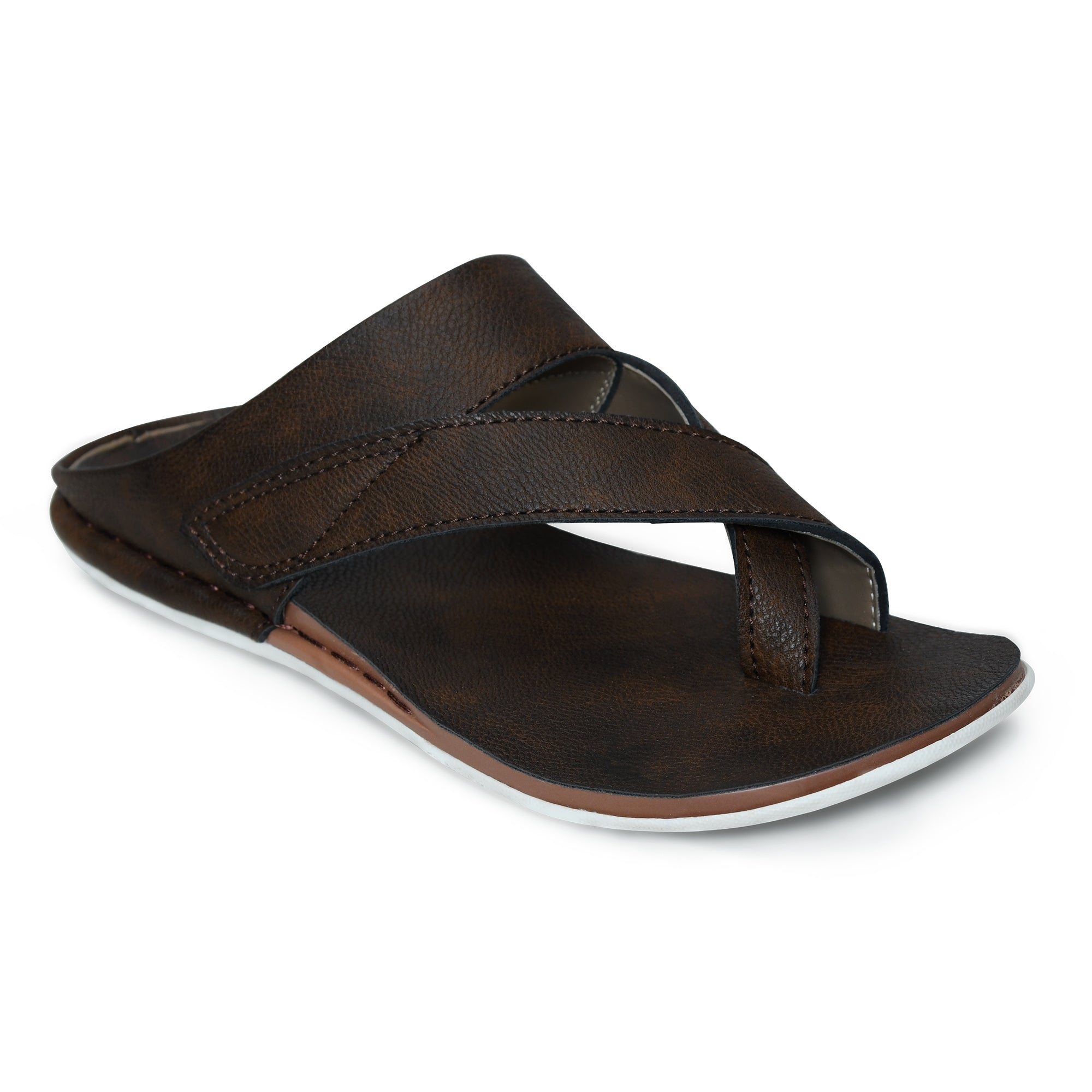
Existing guide image showing a cross-strap shape; it is not a material test or proof of a linked model's construction.
This guide helps STEPSOFT shoppers compare cross-strap, broad-upper and buckle-style slippers without making unsupported environmental or performance claims. It also explains how “faux leather” and “vegan leather” are used in current product names.
Faux leather, vegan claims and genuine leather: what is different?
A faux-leather upper is not animal-hide leather. It is also not, by itself, evidence that the complete slipper is vegan-certified. The upper, lining, footbed, sole, trims and manufacturing materials need their own explanation. A brand name, photograph or word such as “premium” cannot replace that information.
Some leather-look alternatives use synthetic materials such as polyurethane (PU) or polyvinyl chloride (PVC); some plant-labelled alternatives combine plant and synthetic components. That is general material context, not a specification for every STEPSOFT pair. Leather Naturally's consumer material report explains why the exact composition matters. It is a leather-industry source, not proof of a universal environmental winner.
Listing term
Useful starting meaning
What still needs checking
Faux or synthetic leather
A leather-look alternative rather than animal-hide leather
Exact composition, backing and which shoe component the wording describes
Vegan leather
A non-animal material claim used by the seller; not one fixed recipe
Whether the claim covers only the upper or the whole pair, and what evidence supports it
Vegan-certified footwear
A claim that an identified certification scheme covers the specified product
Certifier, exact product coverage and current certificate or official product listing
Genuine or pure leather
An animal-leather claim for the component named by the listing
Which components use leather and what finish and care are specified; not a promise about every component or lifespan
Plant-based alternative
A claim about plant-derived content
Content percentage, other ingredients and coatings; not automatic proof of plastic-free or biodegradable construction
Does a faux upper make the whole slipper vegan?
Do not infer that. Ask about the lining, footbed covering, decorative parts and adhesives as well as the upper and sole. Vegan Action's consumer certification guidance distinguishes a certification from a seller's own wording and explains that its criteria cover animal ingredients, processing and testing. That is the scheme's scope, not a certification held by STEPSOFT.
If a seller cannot provide whole-product evidence, the vegan status of the complete pair remains unverified. Absence of a certificate does not by itself prove that animal materials are present; it means you should not describe the pair as certified.
Which material lasts longer, feels cooler or handles rain better?
There is no supported universal winner for the products in this guide. Upper finish, lining, seams, sole attachment, use and care all matter. Do not turn “faux,” “vegan,” “genuine” or a higher price into a guarantee of years of wear, cooling, grip, waterproofing or all-day comfort.
For a rain-specific purchase, use the men's monsoon footwear checklist. For an animal-leather option, compare the separate leather slipper buying guide. These are different buying paths, not evidence that one material is automatically better.
What should you do when product details conflict?
Pause before ordering and ask for the exact model's specification. If a title says faux leather but a Manufacturer or Care block says genuine leather, do not pick whichever statement sounds more reassuring. Save the product link and ask which component each statement describes, what care applies and whether the listing will be corrected. A generic leather-conditioning instruction is not suitable evidence for an unspecified synthetic finish.
A ready-to-use material question for the seller
For this exact product and selected size/colour, please confirm the upper, lining, footbed covering, outsole, trims and adhesives. Does any vegan claim cover the entire pair? If certified, which organisation and product reference apply? Please also confirm the care instructions where the page gives different material descriptions.
Choose the strap shape first
Cross-strap styles
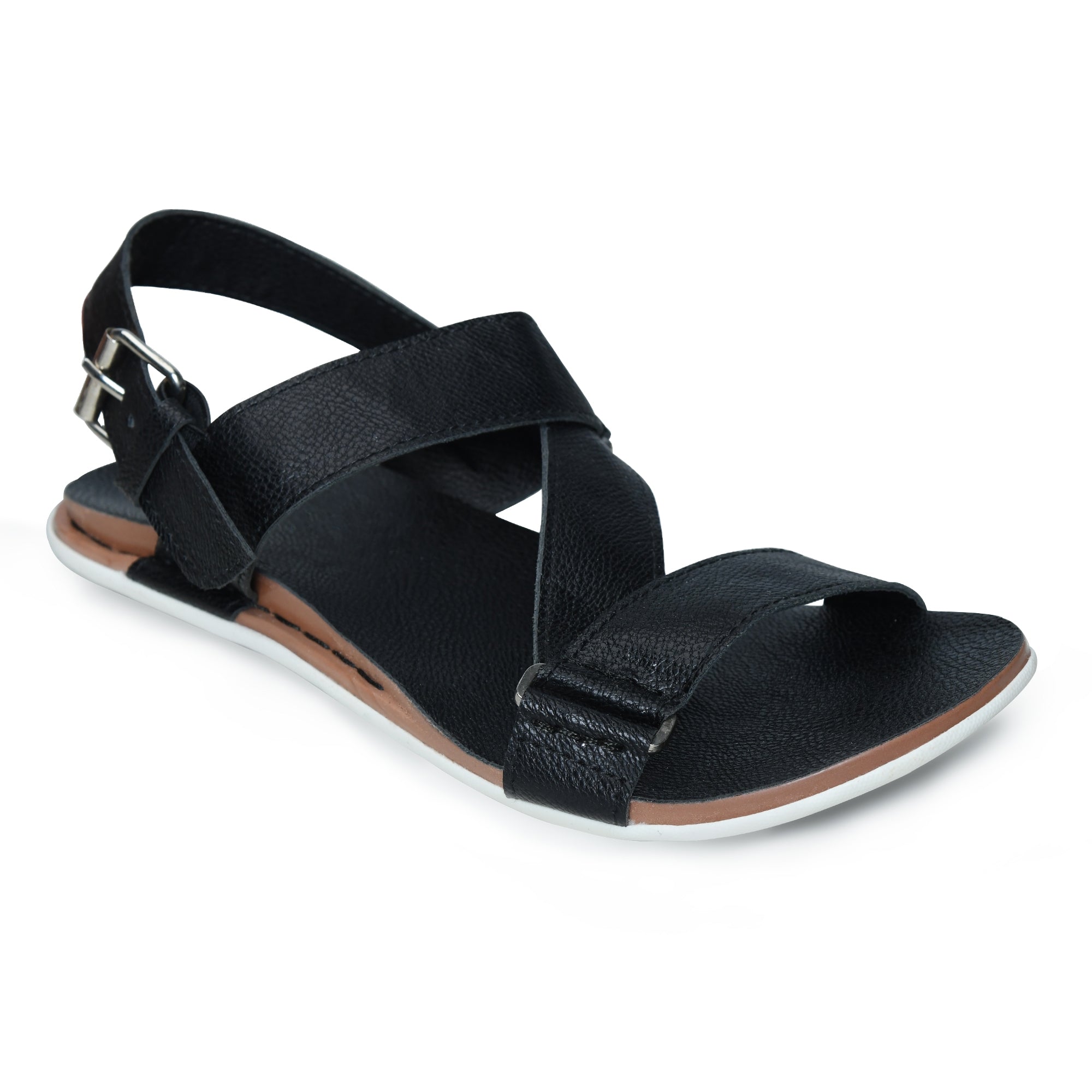
Cross straps cover more of the upper foot than a simple toe-post design. Compare where the straps cross, how wide they appear and how much of the forefoot remains open. The cross-strap images in this guide illustrate a shape; they do not establish the construction or material of every linked product. Inspect the chosen model's own photographs and specification.
A cross-strap view helps you compare coverage and opening shape; fit still depends on your foot and selected size.
Broad-upper or slide styles
A broad upper can feel different across the instep because it contacts a larger area. Check the opening height and the side profile in product photos. If your instep is high, a visual comparison and an indoor try-on are more useful than assuming a broad strap will loosen.
Buckle-style designs
A buckle visible in the design may be decorative or functional. Do not assume adjustability without reading the exact page. The men’s buckle-strap slipper listing owns the current construction, size and availability details for that model.
Match the slipper to your intended use
Home and quick errands: compare easy on/off, footbed coverage and whether the upper creates pressure.
Casual outfits: choose a colour and finish that works with the clothes you actually wear, then check fit.
Longer walking: do not assume a casual slip-on is designed for extended distance; use the exact product wording and consider a sandal with more hold.
Wet or changing conditions: look for an explicit exact-product statement. Faux-leather wording does not by itself make the full pair waterproof.
Formal or ethnic outfits: compare the visual finish, coverage and colour, but keep occasion styling separate from performance claims.
Fit checklist for men’s slippers
Measure both feet and start with the larger foot.
Check the exact selectable sizes; do not rely only on the number worn in another brand.
Confirm that heel, toes and forefoot stay within the footbed.
Check whether the upper creates sharp pressure across the instep.
Walk a few steps on a clean indoor surface and notice sliding, twisting or toe gripping.
A correct length does not guarantee a correct upper fit. Two slippers with the same size label can have different strap positions and opening shapes.
The side view shows the relationship between upper and footbed on this product example; it does not establish universal comfort or support.
Care without guessing the material
Follow the exact product care instructions when provided. If the listing does not specify a cleaner or conditioner, do not automatically use products made for animal-hide leather. First remove dry surface dust with a soft, clean cloth. For stains, uncertain finishes or bonded layers, contact STEPSOFT with the product link before applying liquid, polish, oil or heat.
Keep the pair away from direct heat while drying and avoid describing it as waterproof unless the current listing explicitly supports that claim. For material-specific cleaning decisions, use the STEPSOFT footwear-care decision guide, while noting that its advice begins with checking the exact finish.
Five customer questions
1. Are faux leather and vegan leather exactly the same?
Not as a complete specification. Retail labels can overlap, but neither proves one fixed composition. A faux-leather upper does not establish the vegan status or certification of the complete pair.
2. Is faux leather waterproof?
Do not assume it. The complete slipper includes upper, seams, straps, footbed and sole. Look for an explicit claim for the exact pair.
3. Is faux leather more eco-friendly than leather?
That cannot be concluded from the label alone. A supportable comparison needs evidence about materials, production, use and disposal.
4. How should a slip-on slipper fit?
Your foot should remain inside the footbed, the upper should not create sharp pressure, and the pair should stay reasonably stable during a clean indoor check.
5. Can I use leather conditioner on faux leather?
Not by default. Use only care products approved for the exact finish; otherwise ask STEPSOFT before applying anything.
Compare current listings, then verify the pair
The Designer Faux Leather Slippers for Men and buckle-strap slipper listing had stocked variants when checked on 16 October 2026. Some buckle-style size/colour combinations were unavailable. These links are places to inspect live options, not recommendations of independently tested performance or certified vegan construction.
Check your selected size and colour, read the component details and resolve any conflicting material or care wording before buying. Compare more shapes in the men's slippers collection. If you prefer an ethnic silhouette, the Kolhapuri collection and Peshawari collection offer separate style comparisons; neither category name guarantees a particular material.
How this guide was prepared
Reviewed by the STEPSOFT content team on 16 October 2026. This update keeps the existing faux-leather slipper buying intent and adds component-level material and vegan-claim checks. We reviewed current native catalogue availability and wording, the live guide and accessible specialist footwear pages from Ethik and BIRKENSTOCK, alongside the two factual sources linked above. Catalogue wording is not independent product testing or whole-shoe certification. We make no universal environmental, waterproof, grip, medical, durability or comfort promise.