Exceptional Customer Service @ 9336832036
Buy more save more - Buy 2 pairs — extra 10% off
Buy 1 Pair of Flip Flops, Get 1 Pair FREE!
Extra 5% OFF on Prepaid Orders + Free shipping
Exceptional Customer Service @ 9336832036
Buy more save more - Buy 2 pairs — extra 10% off
Buy 1 Pair of Flip Flops, Get 1 Pair FREE!
Extra 5% OFF on Prepaid Orders + Free shipping
Exceptional Customer Service @ 9336832036
Buy more save more - Buy 2 pairs — extra 10% off
Buy 1 Pair of Flip Flops, Get 1 Pair FREE!
Extra 5% OFF on Prepaid Orders + Free shipping
Exceptional Customer Service @ 9336832036
Buy more save more - Buy 2 pairs — extra 10% off
Buy 1 Pair of Flip Flops, Get 1 Pair FREE!
Extra 5% OFF on Prepaid Orders + Free shipping
Exceptional Customer Service @ 9336832036
Buy more save more - Buy 2 pairs — extra 10% off
Buy 1 Pair of Flip Flops, Get 1 Pair FREE!
Extra 5% OFF on Prepaid Orders + Free shipping
Exceptional Customer Service @ 9336832036
Buy more save more - Buy 2 pairs — extra 10% off
Buy 1 Pair of Flip Flops, Get 1 Pair FREE!
Extra 5% OFF on Prepaid Orders + Free shipping
Exceptional Customer Service @ 9336832036
Buy more save more - Buy 2 pairs — extra 10% off
Buy 1 Pair of Flip Flops, Get 1 Pair FREE!
Extra 5% OFF on Prepaid Orders + Free shipping
Exceptional Customer Service @ 9336832036
Buy more save more - Buy 2 pairs — extra 10% off
Buy 1 Pair of Flip Flops, Get 1 Pair FREE!
Extra 5% OFF on Prepaid Orders + Free shipping
Exceptional Customer Service @ 9336832036
Buy more save more - Buy 2 pairs — extra 10% off
Buy 1 Pair of Flip Flops, Get 1 Pair FREE!
Extra 5% OFF on Prepaid Orders + Free shipping
Exceptional Customer Service @ 9336832036
Buy more save more - Buy 2 pairs — extra 10% off
Buy 1 Pair of Flip Flops, Get 1 Pair FREE!
Extra 5% OFF on Prepaid Orders + Free shipping
Men can wear ethnic footwear with jeans when the shoe remains visible and the rest of the outfit has a clear level of formality. Straight or tapered jeans usually reveal a Kolhapuri-style chappal, ethnic sandal, jutti or loafer more clearly than a hem that collapses over the shoe. Start with the setting—casual, smart-casual or Indo-western—then choose one footwear shape, compare its colour with the denim and shirt, and verify the exact product details before ordering.
By Hammad Shahid for STEPSOFT. Catalogue and links checked 17 September 2026.
A beige T-strap Kolhapuri-style chappal shown as one current STEPSOFT example. The image illustrates shape and colour only; check the exact listing for product claims.
What does “ethnic footwear with jeans” mean?
Ethnic footwear with jeans is an Indo-western styling combination in which a recognisably Indian footwear shape—such as a Kolhapuri-style chappal, jutti, mojari or Peshawari sandal—is paired with denim. A loafer can also bridge the two wardrobes when its shape and finish suit the outfit. The combination works best when it looks intentional: the hem exposes the footwear, the shirt supports the same formality, and the colour contrast is controlled.
This URL owns jeans and Indo-western styling intent. Kurta-pajama questions belong to the separate kurta footwear guide.
Quick outfit matcher
Jeans and top
Footwear starting point
Keep in mind
Dark straight jeans + plain shirt
Kolhapuri-style chappal or restrained sandal
Let the open footwear be the ethnic accent
Dark tapered jeans + short kurta
Jutti, mojari or Peshawari shape
Check that the hem clears the footwear
Black jeans + solid overshirt
Black sandal or black loafer
Texture can create contrast without adding another colour
Medium-blue jeans + neutral polo or shirt
Brown, tan or beige open footwear
Compare the warmth of the footwear with the top
Dark clean denim + bandhgala-style layer
Closed jutti or loafer
Choose the shape by occasion formality
Choose the jeans cut before the footwear
The useful question is not “skinny or baggy?” but “can the footwear be seen in the intended proportion?” A straight or tapered hem often keeps the shoe visible without clinging to the leg. A very long or wide hem can cover a low slip-on, and a heavily stacked hem can make the lower half look accidental. You do not need to crop or cuff every pair; you do need to see how the actual hem meets the actual footwear.
Try the combination in a full-length mirror. Check the front, side and a few steps of movement. If the hem catches on a strap or hides most of the shoe, change the jeans or the footwear rather than forcing the pairing.
Four footwear shapes and the signals they send
Kolhapuri-style chappal: relaxed ethnic contrast
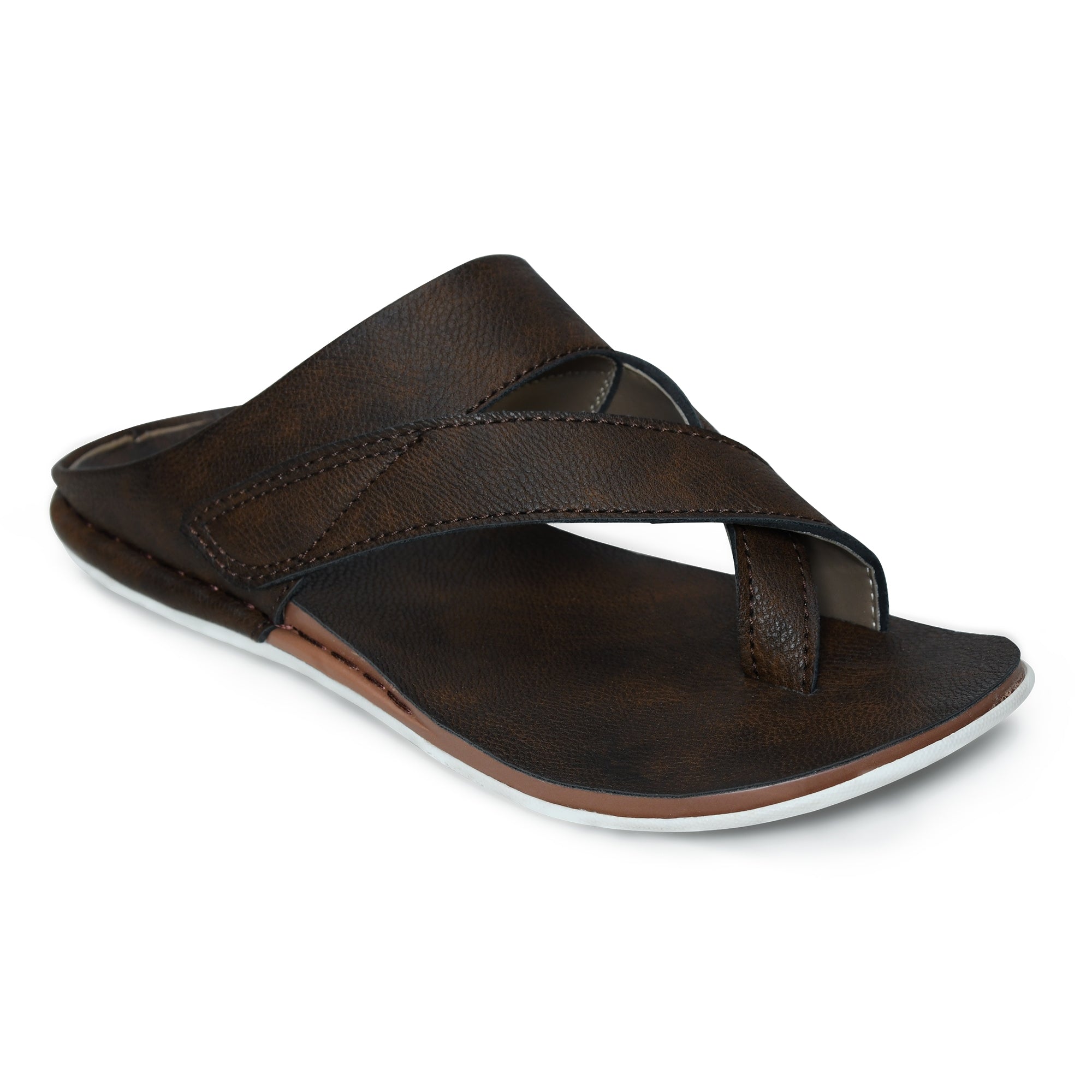
An open T-strap or toe-loop shape creates the strongest casual contrast with denim. It can work with a plain shirt, linen-style top or short kurta when the setting allows open footwear. Keep product claims separate from appearance: visible straps do not prove leather type, grip, durability or comfort.
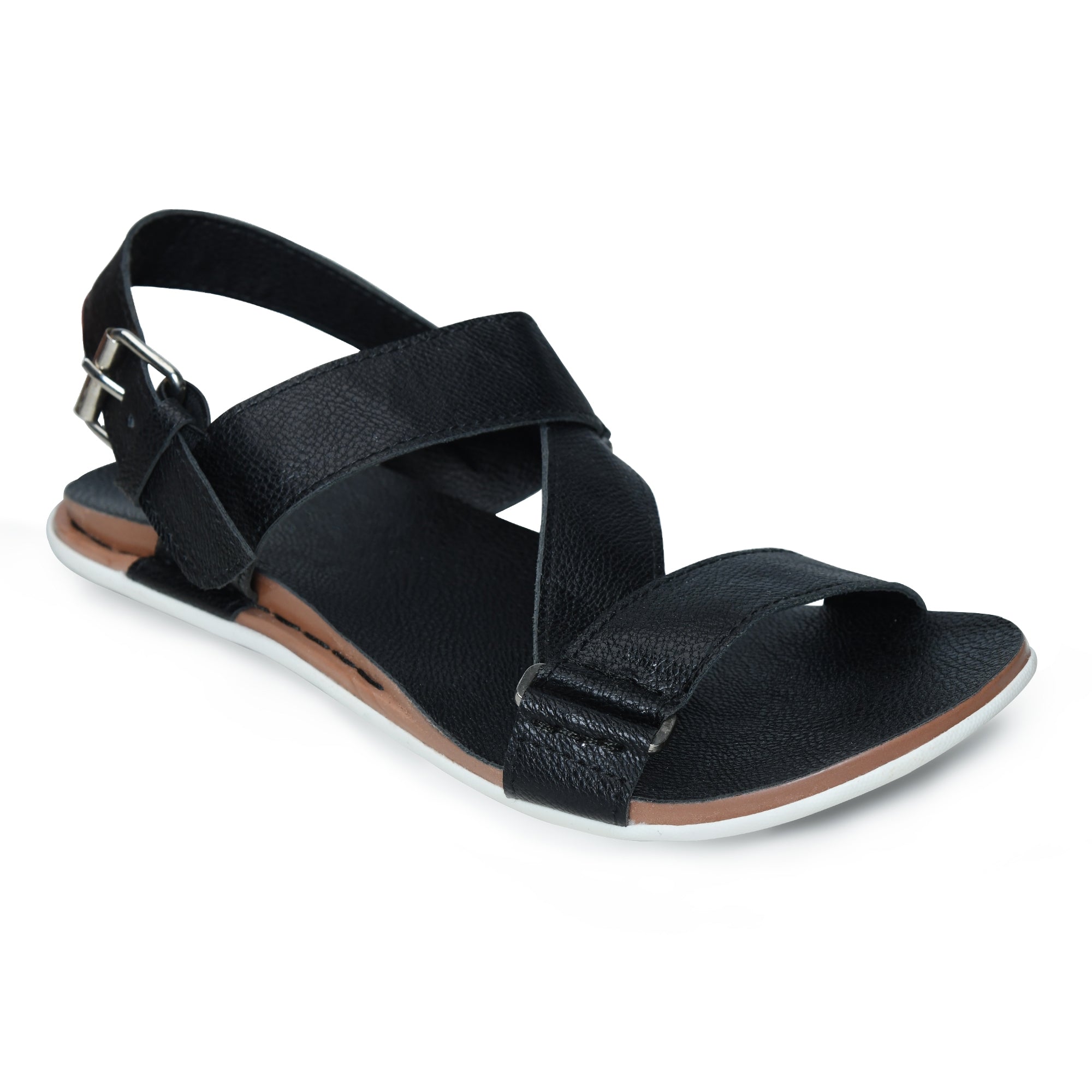
A side-thumb sandal can show more upper structure than a simple V-strap slipper. With dark jeans, a black or brown example can create a quieter transition from denim to footwear. The toe-loop and strap position matter to fit, so an indoor trial is more useful than a broad category rule.
A black side-thumb sandal illustrates a structured open option with jeans. See the exact side-thumb sandal product page for current details.
Jutti or mojari: clearer Indo-western statement
A closed jutti or mojari makes the ethnic element more deliberate. It can suit dark jeans with a short kurta, band-collar shirt or simple jacket. Compare the toe shape and upper detail with the jeans wash. If the shoe is patterned, keep the top relatively quiet so that two strong visual elements do not compete.
A horsebit loafer reads closer to a western slip-on, so it can be the easiest transition for an office-casual dinner or a cleaner evening outfit. Its visible hardware raises the formality compared with a plain slipper. Check whether the metal detail, colour and finish work with the shirt, belt and setting.
A black horsebit loafer shows the closed smart-casual option. Review the exact horsebit loafer listing for current product information.
A five-step mirror test
Check visibility. The hem should not hide the defining part of the footwear.
Check formality. Open sandals suit different settings from closed loafers or juttis.
Check colour balance. Repeat or relate one colour; do not require every brown or black to match exactly.
Check visual competition. If the footwear is detailed, simplify the shirt or outer layer.
Check fit indoors. Walk on a clean surface and look for toe pressure, strap rubbing, heel instability or a hem that catches.
Five questions about ethnic footwear with jeans
Can men wear Kolhapuri chappals with jeans?
Yes. A visible straight or tapered hem, a simple top and a setting appropriate for open footwear make the pairing easier to read.
Can I wear a Peshawari sandal with jeans?
Yes, especially with dark denim and a short kurta or plain shirt. Compare the closed-toe or strap structure with the outfit and use the exact listing for fit and material details.
Do light-wash jeans work with ethnic footwear?
They can. Light denim creates more contrast, so a neutral top and restrained footwear often make the combination easier to balance. There is no universal ban on a wash.
Should I cuff my jeans?
Only if the cuff improves the proportion and does not look bulky. The goal is visibility, not a mandatory cuff.
Are loafers ethnic footwear?
A loafer is generally a western slip-on shape, but it can bridge casual and Indo-western outfits. Use jutti, mojari, Peshawari or Kolhapuri-style options when you want a more distinctly ethnic silhouette.
How this guide was prepared
STEPSOFT reviewed the live article map, current product catalogue and public product imagery on 17 September 2026. The outfit suggestions describe visual relationships rather than universal fashion rules. Images show exact current catalogue examples, but do not prove unstated materials, performance, origin or fit. Product availability and specifications should be rechecked on the linked product page.