Exceptional Customer Service @ 9336832036
Buy more save more - Buy 2 pairs — extra 10% off
Buy 1 Pair of Flip Flops, Get 1 Pair FREE!
Extra 5% OFF on Prepaid Orders + Free shipping
Exceptional Customer Service @ 9336832036
Buy more save more - Buy 2 pairs — extra 10% off
Buy 1 Pair of Flip Flops, Get 1 Pair FREE!
Extra 5% OFF on Prepaid Orders + Free shipping
Exceptional Customer Service @ 9336832036
Buy more save more - Buy 2 pairs — extra 10% off
Buy 1 Pair of Flip Flops, Get 1 Pair FREE!
Extra 5% OFF on Prepaid Orders + Free shipping
Exceptional Customer Service @ 9336832036
Buy more save more - Buy 2 pairs — extra 10% off
Buy 1 Pair of Flip Flops, Get 1 Pair FREE!
Extra 5% OFF on Prepaid Orders + Free shipping
Exceptional Customer Service @ 9336832036
Buy more save more - Buy 2 pairs — extra 10% off
Buy 1 Pair of Flip Flops, Get 1 Pair FREE!
Extra 5% OFF on Prepaid Orders + Free shipping
Exceptional Customer Service @ 9336832036
Buy more save more - Buy 2 pairs — extra 10% off
Buy 1 Pair of Flip Flops, Get 1 Pair FREE!
Extra 5% OFF on Prepaid Orders + Free shipping
Exceptional Customer Service @ 9336832036
Buy more save more - Buy 2 pairs — extra 10% off
Buy 1 Pair of Flip Flops, Get 1 Pair FREE!
Extra 5% OFF on Prepaid Orders + Free shipping
Exceptional Customer Service @ 9336832036
Buy more save more - Buy 2 pairs — extra 10% off
Buy 1 Pair of Flip Flops, Get 1 Pair FREE!
Extra 5% OFF on Prepaid Orders + Free shipping
Exceptional Customer Service @ 9336832036
Buy more save more - Buy 2 pairs — extra 10% off
Buy 1 Pair of Flip Flops, Get 1 Pair FREE!
Extra 5% OFF on Prepaid Orders + Free shipping
Exceptional Customer Service @ 9336832036
Buy more save more - Buy 2 pairs — extra 10% off
Buy 1 Pair of Flip Flops, Get 1 Pair FREE!
Extra 5% OFF on Prepaid Orders + Free shipping
Are Sandal and Shoe Sizes the Same? Men’s Fit Guide
Hammad Shahid
0 comments
Sandal and shoe sizes are not automatically interchangeable. The same printed size can feel different because a loafer encloses the foot, a jutti has a different vamp and toe shape, and an open sandal or flip-flop depends on footbed length plus strap placement. Measure both feet, use the longer measurement, then check the exact product’s size options and indoor fit instead of assuming your usual shoe number will transfer.
A current STEPSOFT slip-on loafer. Enclosed uppers make toe room, instep pressure and heel movement important.
This is a measurement-and-check guide, not a universal STEPSOFT conversion chart. Sizes and fit can vary by product construction, so the product listing and a clean indoor try-on remain decisive.
Why the same size can feel different
Footwear type
Main fit checks
Common assumption to avoid
Loafer
Toe room, instep pressure, heel movement
Any slip means the size is wrong
Jutti, mojari or nagra
Toe shape, vamp pressure, opening and heel entry
All ethnic slip-ons use one last or chart
Kolhapuri-style chappal
Footbed length, toe-loop or strap placement
Open toes remove the need for sizing
Peshawari-style sandal
Front coverage, crossing upper, side openings and heel
A sandal must fit like a flip-flop
EVA flip-flop
Footbed boundary, toe-post position and strap pressure
Extra footbed length is always harmless
How to measure your feet at home
Place a sheet of paper on a hard, level floor with one edge against a wall.
Stand on the paper with your heel lightly touching the wall. Put weight on the foot naturally.
Mark the tip of the longest toe. Repeat for the other foot because the measurements can differ.
Measure from the paper’s wall edge to each mark in millimetres or centimetres.
Use the longer measurement as the starting point and repeat if the marks are unclear.
This follows the general foot-measurement method used by footwear brands such as ASICS India; it does not adopt another brand’s size conversion for STEPSOFT products. Measure late in the day if practical, and use the socks you expect to wear with enclosed footwear.
Open footwear still needs a boundary check
An open toe does not make size irrelevant. Your heel and toes should remain within the product’s footbed, and the toe loop, post or strap should not create concentrated pressure. Look at the product image from above and from the side if both are available. A long footbed with a badly placed strap can still feel wrong, while a visually close edge may not provide enough room during movement.
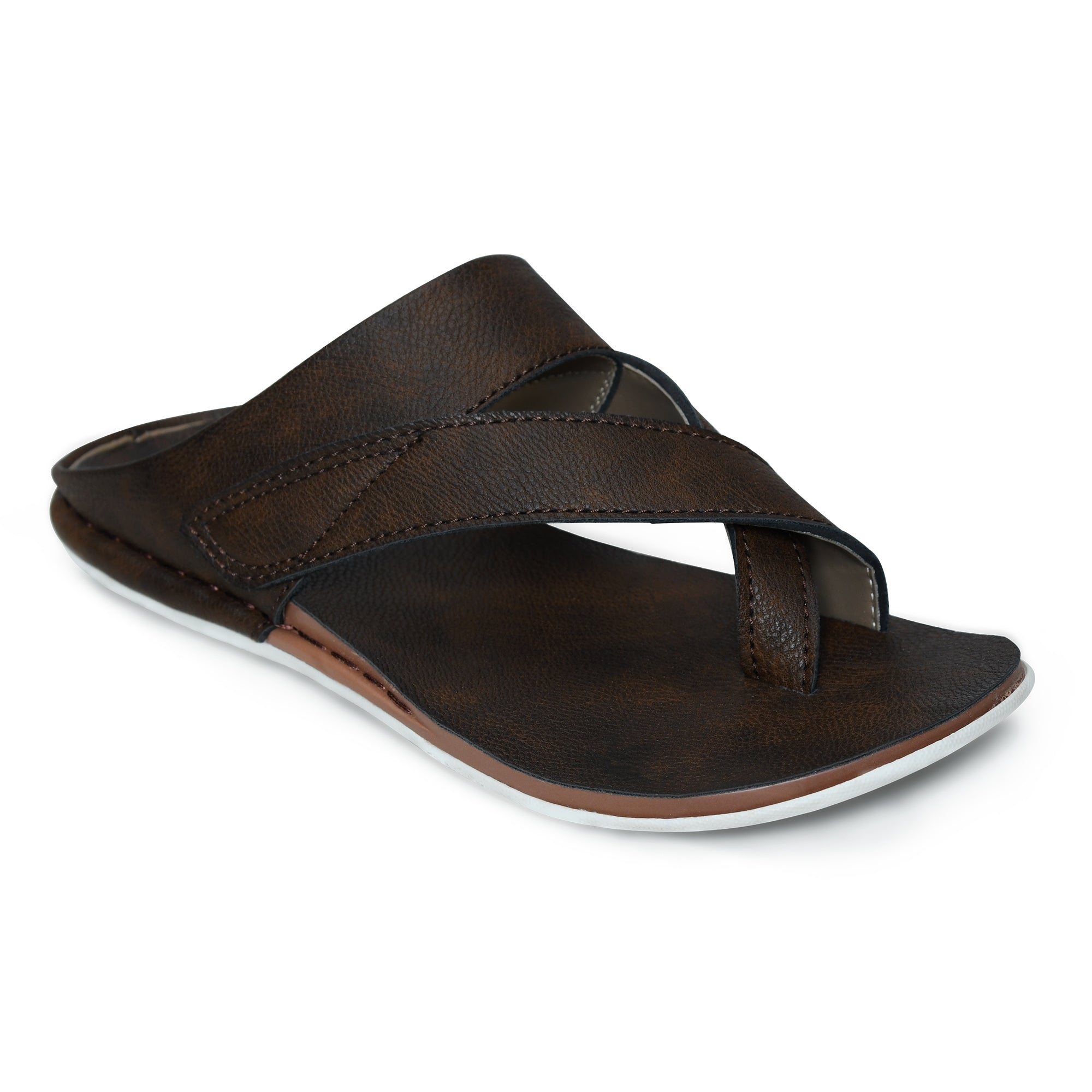
A current V-strap slipper. Check where the straps meet the foot as well as the total footbed length.
Enclosed footwear adds volume checks
For loafers and juttis, length is only one dimension. The upper crosses the instep and surrounds more of the forefoot, so two products with the same marked size can feel different. During an indoor try-on, notice whether pressure is spread evenly or concentrated at the longest toe, widest point or top of the foot. Do not rely on a promise that a pair will stretch or break in unless the exact product provides supported guidance.
For loafers specifically, a small amount of movement can occur in a slip-on construction, but the foot should not lift out uncontrollably. STEPSOFT’s loafer fit guide gives a focused heel-slip checklist. For open ethnic footwear, use the Kolhapuri measurement guide.
Do not mix size systems without evidence
A number such as 8 does not identify the sizing system by itself. UK, US, EU and brand-specific conventions are not interchangeable. If the exact listing displays only one set of selectable sizes, use that listing’s own guidance rather than adding an assumed conversion. When no conversion is published, record your foot length and contact customer support before ordering if you are between options.
Printable indoor fit checklist
The pair matches the product and selected size on the order.
Both feet stay inside the footbed or upper boundary.
There is no sharp pressure at the toe, instep, strap, loop or post.
The heel does not escape the footwear during a normal step.
You can take ten steps, turn and sit without concentrated rubbing.
You tested on a clean indoor surface and kept packaging until deciding.
A current EVA flip-flop. The toe post, V-strap and footbed boundary create different checks from an enclosed loafer.
Questions about sandal and shoe sizing
Are sandal and shoe sizes the same?
Not reliably. The printed size may match, but shape, coverage, straps and the product’s last can change the fit.
Should I size down for open sandals?
Not as a universal rule. Measure your feet and verify that the exact footbed contains both heel and toes.
Should loafers feel tight when new?
They should feel secure, not painfully tight. Do not assume harmful pressure will disappear later.
What if my feet measure differently?
Use the longer foot as the starting point, then check both feet during the indoor try-on.
Can I use another brand’s conversion chart?
Use it for that brand only. It should not be treated as an official STEPSOFT conversion unless STEPSOFT publishes the same mapping.
How this guide was prepared
Prepared by Hammad Shahid for STEPSOFT on 24 September 2026. We compared visible structures in current published STEPSOFT loafers, slippers and EVA flip-flops, and used the ASICS India page only for the general method of measuring a foot. We did not create an unsupported universal conversion table or infer stretch, support, medical benefit or comfort performance.
Next step: record both foot lengths, then compare the exact options in the live STEPSOFT catalogue before choosing a pair.